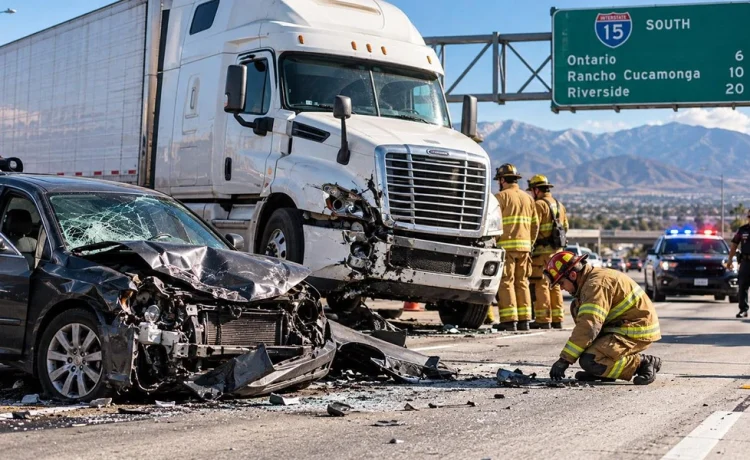
After a truck accident on the I-15, the driver is rarely the only party who can be held responsible. The trucking company, the business that loaded the cargo, a maintenance shop, a parts manufacturer or even a public agency may share liability. Federal rules on driver hours, inspections and insurance often decide these cases. Key evidence such as electronic logs can disappear within months, so talk to a truck accident lawyer in the Inland Empire quickly.
Introduction
A truck accident on the I-15 doesn’t feel like a normal crash. One moment you’re heading down the Cajon Pass or merging near Ontario, and the next an 80,000-pound rig is where your lane used to be. If you or someone you love was hurt in a collision like that, the injuries are often serious and the questions come fast.
That matters because each of those parties may carry its own insurance, and trucking companies move quickly to protect themselves. This guide explains who can be liable after an I-15 truck crash in the Inland Empire, which rules apply, and what to do now.
Why the I-15 Sees So Many Truck Crashes in the Inland Empire
The I-15 is one of Southern California’s main freight corridors. Trucks carry goods between the ports, the Inland Empire’s warehouse hubs, Las Vegas and points north and east. That volume, combined with steep grades, weather and congestion, makes the corridor a frequent site of serious truck collisions.
The Cajon Pass is the best-known trouble spot. Its long, steep grade between Devore and the summit punishes brakes on the way down and slows loaded trucks to a crawl on the way up, creating big speed differences between trucks and cars. High winds, fog and winter storms add to the danger, and the merge where the 215 meets the 15 near Devore keeps lanes busy.
Further south, the stretch through Rancho Cucamonga, Fontana, Ontario, Eastvale and Jurupa Valley runs past some of the largest concentrations of distribution centers in the country. Trucks constantly enter and exit the freeway, and the interchanges with the 10 and the 60 see heavy weaving. Through Corona, Temecula and Murrieta, commuter traffic mixes with trucks heading to and from San Diego.
Add weekend traffic to and from Las Vegas, and you have a road where tired drivers, tight schedules and heavy loads come together every day.
Who Can Be Liable for a Truck Accident on the I-15?
Liability after a truck accident on the I-15 can extend to the truck driver, the motor carrier that employs or contracts with the driver, the owner of the truck or trailer, the company that loaded the cargo, a maintenance provider, a parts manufacturer, and occasionally a government agency responsible for the road. Each one may have separate insurance.
Here’s how each party may be involved:
- The truck driver. Speeding on a grade, following too closely, fatigue, distraction, impairment or an unsafe lane change.
- The trucking company. In California, employers are generally responsible for the careless acts of employees on the job. Carriers can also be directly liable for hiring unqualified drivers, ignoring safety violations or pushing schedules that require breaking hours-of-service rules.
- The truck or trailer owner. When the tractor and trailer belong to different companies, both may be involved.
- The shipper or loader. Overloaded, unbalanced or poorly secured cargo can shift on a curve or overwhelm brakes on a descent.
- The maintenance provider. Worn brakes, bad tires and skipped inspections are common factors in runaway-truck and blowout crashes.
- The manufacturer. A defective brake component, tire or steering part can support a product liability claim.
- A public agency. Dangerous road design, missing signs or poor maintenance can point to Caltrans or a local agency, with much shorter deadlines.
Trucking companies sometimes argue the driver was an independent contractor, not an employee. That label isn’t the end of the story. Federal rules make motor carriers responsible for safety on vehicles operating under their authority, and California courts look at how the relationship actually worked, not just what the contract says.
In a truck crash, the driver is often just the first name on a much longer list.
Federal Trucking Rules That Often Decide Fault
Commercial trucks are governed by federal safety rules from the Federal Motor Carrier Safety Administration (FMCSA). When a driver or carrier breaks those rules and a crash follows, the violation can be powerful evidence of negligence.
The most important are the hours-of-service rules. Property-carrying drivers generally may drive no more than 11 hours within a 14-hour window after 10 consecutive hours off duty, must take a 30-minute break after 8 hours of driving, and face weekly caps of 60 or 70 hours. Most trucks now record their hours with electronic logging devices.
Other rules cover drug and alcohol testing, driver qualifications, vehicle inspections and maintenance records, and cargo securement. A carrier that skipped required inspections or kept a driver with a history of violations on the road may face direct liability.
Insurance rules matter too. Federal regulations generally require interstate carriers hauling ordinary freight to carry at least $750,000 in liability coverage, with higher minimums for certain hazardous materials. California sets similar minimums for many carriers operating within the state. That’s far more than the $30,000 per-person minimum on a personal auto policy, which is one reason trucking insurers defend these claims so aggressively.
Evidence Disappears Fast After a Truck Crash
The most valuable evidence in a truck case belongs to the trucking company, not to you. Federal rules generally require carriers to keep drivers’ duty-status records and supporting documents for only six months. Dashcam video can be overwritten, and the truck itself may be repaired and back on the road within weeks.
That’s why speed matters. A lawyer can send a preservation demand, sometimes called a spoliation letter, telling the carrier to keep:
- Electronic logging device data and duty-status records
- Engine control module (black box) data showing speed and braking
- Forward-facing and driver-facing camera footage
- Dispatch records, delivery schedules and messages to the driver
- Inspection, maintenance and repair records
- Bills of lading and cargo loading records
- The driver’s qualification file and drug and alcohol test results
On your side, keep photos from the scene, names of witnesses, your medical records and anything you remember about the truck: company name, DOT number on the door, and trailer markings.
Inland Empire Courts, Investigations and Deadlines
The California Highway Patrol investigates crashes on the I-15. For fatal or catastrophic collisions, the CHP may bring in a specialized Multidisciplinary Accident Investigation Team (MAIT) that reconstructs the crash in detail. Ask for the report number at the scene, and expect a serious crash report to take weeks.
Where a lawsuit gets filed depends largely on where the crash happened and where the defendants are located. Crashes in the Cajon Pass, Rancho Cucamonga, Fontana and Ontario typically fall within San Bernardino County Superior Court, which hears unlimited civil cases at locations including the San Bernardino Justice Center. Crashes in Eastvale, Corona, Temecula and Murrieta typically fall within Riverside County Superior Court. Interstate carriers sometimes try to move cases to federal court.
Deadlines are the same as in other injury cases, and they’re strict. Most injury and wrongful death lawsuits must be filed within two years under Code of Civil Procedure section 335.1. If a public agency may share fault, a written government claim is generally due within six months.
How an Inland Empire Truck Accident Lawyer Levels the Field
An Inland Empire truck accident lawyer investigates beyond the driver, preserves the carrier’s records before they’re gone, identifies every liable party and insurance policy, and builds the full value of your injuries. Trucking insurers often have response teams on scene within hours. A lawyer gives you a team of your own.
That investigation can include downloading the truck’s electronic data, reviewing the carrier’s safety history, working with reconstruction and trucking safety experts, and comparing the driver’s logs to fuel receipts, tolls and delivery records.
It also means valuing the case properly. Serious truck crashes often involve spinal injuries, brain injuries, long hospital stays and permanent changes to how you work and live. Those losses deserve a full accounting, not a quick check sized to the insurer’s budget. No lawyer can guarantee an outcome, but you won’t be outmatched.
Learn more about our truck accident practice and broader personal injury work, or visit our Riverside personal injury lawyer page.
Protecting Your Claim After an I-15 Truck Crash
Two takeaways. First, liability in a truck crash often reaches well past the driver to companies with larger insurance policies and stricter legal duties. Second, the trucking company mostly controls the evidence, and some of it can be legally discarded within months.
Oracle Law Firm represents truck crash victims throughout the Inland Empire, from the Cajon Pass to the Temecula Valley, with an office in Ontario just off the I-15 and I-10 corridors.
Been in an accident or hurt on the job? You don’t have to navigate insurance companies alone. Oracle Law Firm fights to get you the compensation, control, and clarity you deserve.
Get a Free Consultation or call 888.597.4099.
Disclaimer: This article is for general information only and is not legal advice. Reading this article does not create an attorney-client relationship. Every case depends on its own facts, and past results do not guarantee future outcomes.
Frequently Asked Questions
Who is liable for a truck accident on the I-15?
Depending on the facts, liability can fall on the truck driver, the trucking company, the truck or trailer owner, the cargo loader, a maintenance provider, a parts manufacturer, or a government agency responsible for the road. Several parties can share responsibility for the same crash.
Can I sue the trucking company if the driver was an independent contractor?
Often, yes. Federal rules make motor carriers responsible for safety on trucks operating under their authority, and California courts look at the real working relationship, not just the contract label. A carrier may also be directly liable for its own hiring and safety failures.
How much insurance do trucking companies have to carry?
Federal rules generally require interstate carriers hauling ordinary freight to carry at least $750,000 in liability coverage, with higher amounts for some hazardous materials. Many carriers carry more. That is far above California’s $30,000 per-person minimum for personal auto policies.
How long do I have to file a truck accident claim in California?
Most truck accident injury and wrongful death lawsuits must be filed within two years. Claims involving a public agency generally require a government claim within six months. Because trucking companies may discard some records after six months, it’s wise to act much sooner.
What if a truck lost its brakes coming down the Cajon Pass?
Brake failure on a grade can point to poor maintenance, an overloaded trailer, improper braking technique, or a defective part. Depending on the cause, the driver, carrier, loader, maintenance shop or manufacturer may be liable. Preserving the truck and its maintenance records quickly is critical.